🚀 AI Development Methodology · Deep Dive
GSD2 vs Claude Code
Orchestrator
They solve completely different problems — and understanding the distinction could change how you build with AI forever.
In the rapidly evolving landscape of AI-assisted software development, two powerful concepts are generating serious buzz among builders: GSD2 — the methodology-driven execution framework — and Claude Code Orchestrator, Anthropic’s technical tooling layer. At first glance they might seem like rivals. Look closer and you’ll see they’re solving fundamentally different problems.
This post will break down exactly what each one is, how they work, where they diverge, and — most importantly — how the two can work together to supercharge how you build software in the age of AI agents.
“GSD2 is the strategy. Claude Code Orchestrator is the engine. You wouldn’t confuse a GPS route with the car that drives it.”
— Core insight from the GSD2 frameworkWhat Is GSD2?
GSD2 stands for Get Stuff Done, Squared — a methodology and execution framework designed to help developers, teams, and AI-assisted workflows break down complex problems and ship real outcomes fast. It is not a software tool. It is not a platform. It is a thinking system — a set of repeatable practices for working with AI agents effectively.
At its core, GSD2 is built around a deceptively simple loop:
Every task in GSD2 lives inside this cycle. The plan is your SOP.
The execution is delegated to agents. The verify step is non-negotiable.
The Five Pillars of GSD2
GSD2 operationalises complex AI-assisted work through five core behaviours that every practitioner internalises:
- 01Break problems into tasks. Big ambiguous goals become small, verifiable units of work. An agent can execute a well-defined task; it struggles with a vague direction.
- 02Assign tasks to agents. Not all work is equal, and not all agents are equal. GSD2 creates a matching discipline between the nature of a task and the right agent for it.
- 03Loop relentlessly: plan → execute → verify. Speed is not the enemy of quality when the loop is tight. Each iteration produces something verifiable.
- 04Plans are SOPs. A plan in GSD2 is not aspirational — it’s a Standard Operating Procedure. It can be handed directly to an agent or a team member and executed without interpretation.
- 05Focus on shipping real outcomes. Demos, prototypes, and half-finished features are not outcomes. GSD2 is relentless about delivery: working software, tested results, measurable progress.
The tagline says it all: Process + Discipline + Delivery. GSD2 is a system for humans (and agents) who are serious about finishing what they start.
What Is Claude Code Orchestrator?
Claude Code Orchestrator is Anthropic’s technical tooling layer — a platform-level capability that allows developers to run AI agents, manage context windows, execute code workflows, and coordinate multi-step tasks programmatically. Think of it as the infrastructure that makes agentic AI possible at scale.
Where GSD2 asks “How should we think about this work?”, Claude Code Orchestrator asks “How do we make the machines actually do the work reliably?”
What Claude Code Orchestrator Gives You
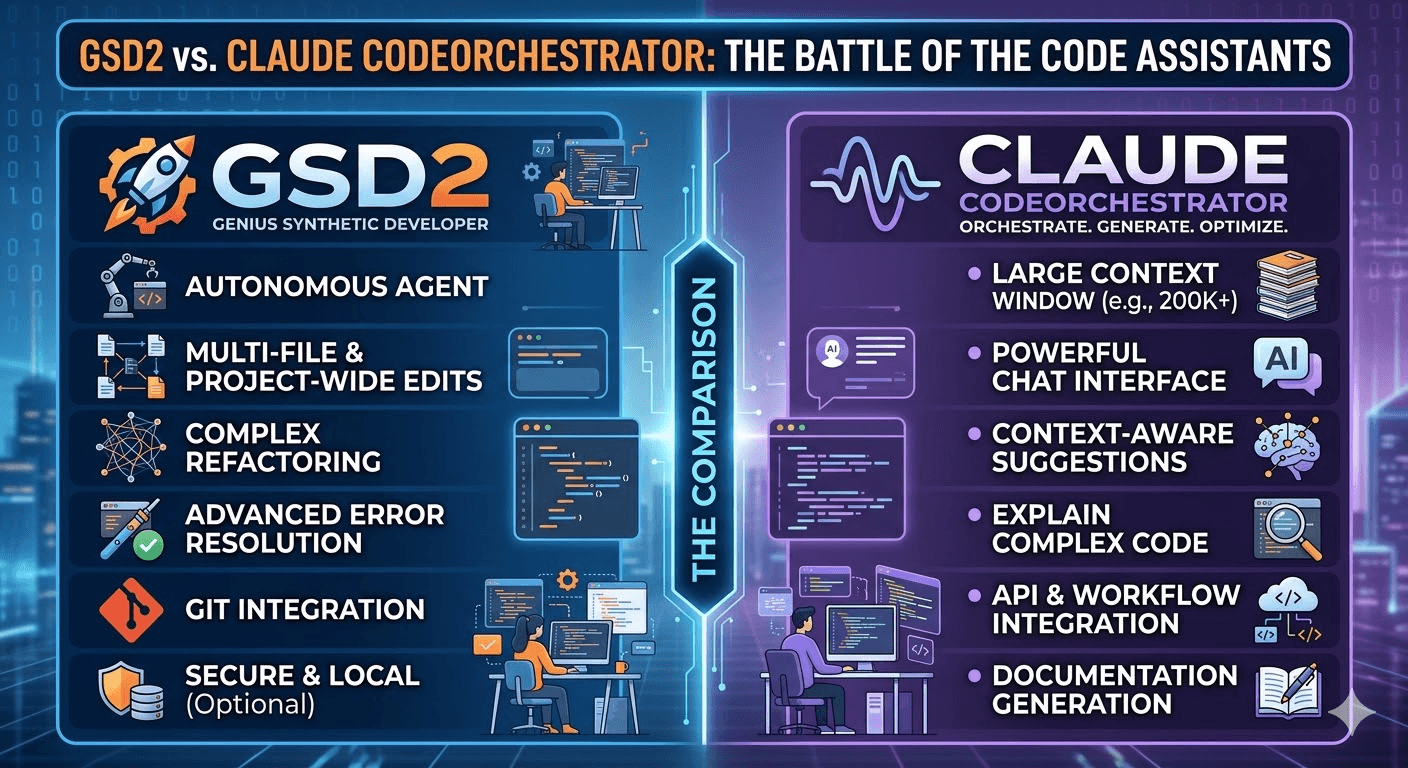
GSD2
Methodology + Execution Framework- Break problems into tasks
- Assign tasks to agents
- Loop: plan → execute → verify
- Plans are SOPs
- Focus on shipping real outcomes
Claude Code Orchestrator
Tooling Layer · Anthropic- Run agents
- Manage context
- Execute code workflows
- Coordinate tasks programmatically
- Capability + Infrastructure
The Claude Code Orchestrator doesn’t tell you how to think about your project. It gives you the power to execute once you’ve figured that out. It runs agents, maintains context across complex multi-step workflows, and connects programmatic coordination with AI capabilities. Its foundation is technical — it’s a platform play, not a methodology play.
The Key Differences, Unpacked
The comparison chart below cuts right to the heart of what distinguishes these two approaches across five critical dimensions:
| Dimension | GSD2 | Claude Code Orchestrator |
|---|---|---|
| Nature | Framework / Methodology | Tool / Platform |
| Focus | Execution methodology | Agent orchestration |
| Goal | Ship outcomes fast | Enable agent workflows |
| Layer | Conceptual + practical | Technical |
| Dependency | Tool-agnostic | Platform-specific |
That last row — Dependency — is particularly telling. GSD2 is tool-agnostic. You can apply its methodology with Claude, GPT-4, Gemini, or even a team of humans. Claude Code Orchestrator, on the other hand, is platform-specific: it is Anthropic’s layer, built for Claude-based workflows. The framework travels. The tool is fixed to its platform.
Why the Distinction Matters in Practice
Many developers make the mistake of treating these as competing choices — as if you have to pick a side. This fundamentally misunderstands what each is designed to do.
Imagine you’re building a complex SaaS feature with multiple moving parts: a data pipeline, a frontend component, API integrations, and tests. Here’s how the two work in tandem:
→ Break the feature into 6 discrete tasks
→ Define the SOP for each (inputs, outputs, acceptance criteria)
→ Assign tasks to appropriate agents
→ Loop through plan → execute → verify for each
→ Don’t call it done until it ships
Claude Code Orchestrator then executes:
→ Spins up agents for each task
→ Manages context so they don’t lose state
→ Coordinates the programmatic dependencies
→ Handles the code workflow end-to-end
GSD2 is the what and why. Claude Code Orchestrator is the how. Strip away the methodology and your orchestrator runs without direction. Strip away the orchestrator and your methodology has no engine. Together, they are genuinely greater than the sum of their parts.
The “Strategy vs Engine” Mental Model
The framing from Prakash Pandey’s work is exactly right: this is Strategy vs Engine. A racing team needs both a race strategy and a high-performance engine. The strategy without the engine goes nowhere. The engine without a strategy crashes. Elite teams obsess over both.
The same applies here. The best AI-assisted development teams in 2025 are not just power users of Claude Code Orchestrator — they’re operating with a disciplined execution methodology underneath it. GSD2 (or something like it) is the strategic layer that makes the technical capability coherent.
Who Should Use What?
If you’re a solo developer just getting started with AI agents, GSD2’s framework is where you should invest your learning first. Getting the methodology right — learning to decompose problems, write real SOPs, and close the verify loop — will make every tool you pick up more effective.
If you’re a technical team lead building production systems on Anthropic’s stack, Claude Code Orchestrator gives you the programmatic coordination layer to run sophisticated multi-agent workflows reliably. Pair it with GSD2’s discipline and you have a repeatable, scalable system.
If you’re platform-agnostic — using multiple LLMs, or undecided on your AI stack — GSD2 is your best friend precisely because it doesn’t care which tools you use. The methodology transfers. Apply it to whatever engine you have available.
The Bottom Line
GSD2 and Claude Code Orchestrator are not competing products. They are complementary layers of the same modern AI development stack. One is the discipline that ensures you build the right things in the right order. The other is the power that makes building fast and scalable.
The developers who will win in the era of AI agents are not those who use the most powerful tools — they’re the ones who combine powerful tools with rigorous methodology. That combination is what turns raw AI capability into shipped, working software.
As Prakash Pandey frames it perfectly: Different Problems, Different Solutions — and the wisest builders use both.