Introductions
IIf 2025 was the breakthrough year, 2026 is the acceleration phase. Technologies that once felt experimental are now scaling, integrating, and reshaping industries at speed. From hyper-intelligent AI to real-world robotics and biotech revolutions, this year is pushing humanity closer to a fully digital, automated, and augmented future.
When we look back at the history of technology, certain years stand out as turning points—years when theoretical potential finally coalesced into material reality. 1969 was the year of the internet’s birth (ARPANET) and the moon landing. 2007 gave us the iPhone and the smartphone era.
For the mid-21st century, 2026 is that pivotal moment.
It was the year the hype cycle crashed into the physical world, and the physical world won. While previous years were defined by advancements inside screens—faster chatbots, better algorithms—2026 was the year that artificial intelligence, biology, and material science embodied themselves in the way we live, move, and heal.
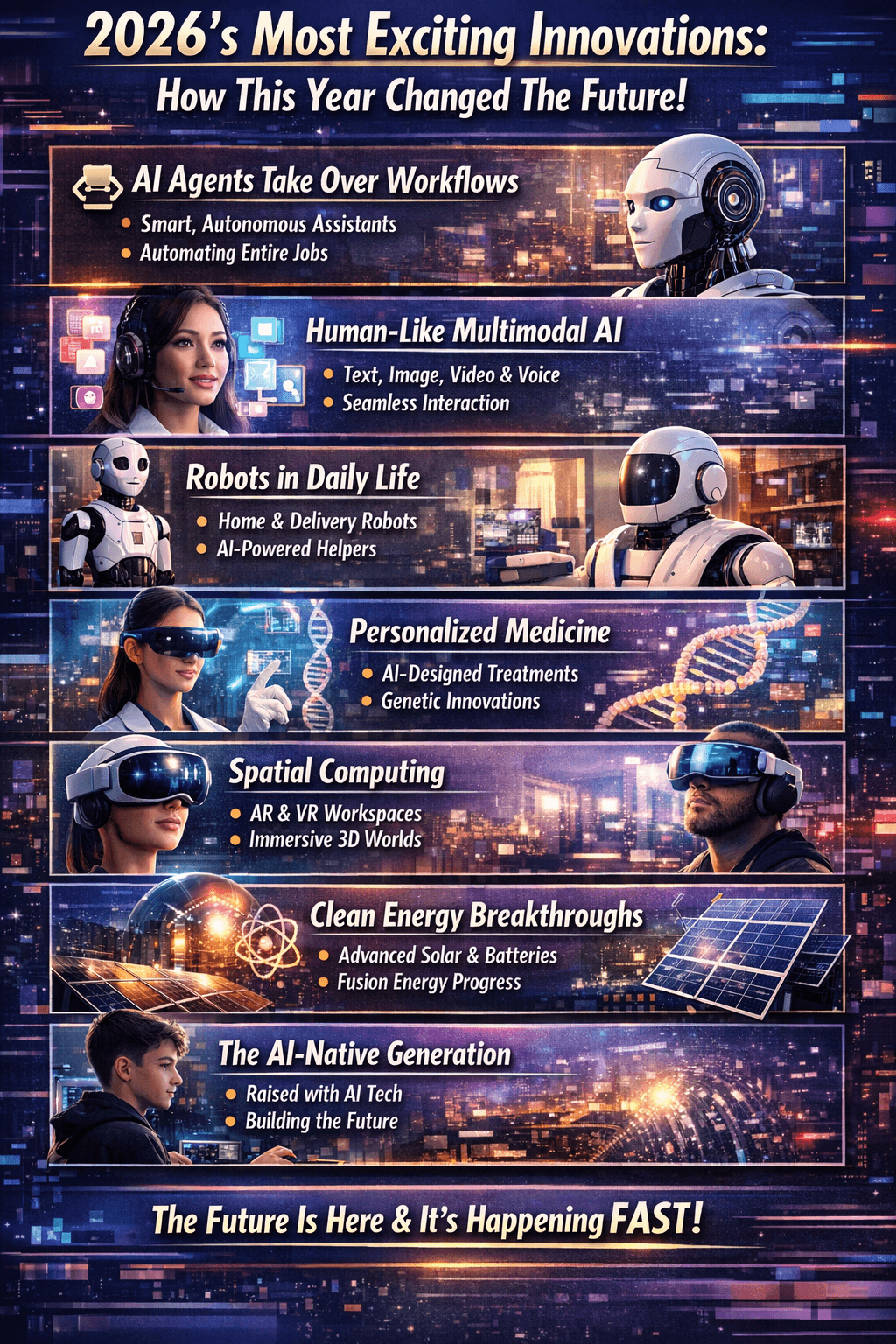
Here is how 2026’s most exciting innovations permanently changed the future.
Here’s a detailed look at the innovations that are redefining 2026—and why they matter.
🤖 1. AI Agents Took Over Workflows
The “chatbot era” officially ended in 2026. Replacing it was the era of Agentic AI—autonomous systems capable of perceiving their digital environments, planning multi-step workflows, and executing complex tasks without constant human prompting.
In 2026, 40% of enterprise applications were classified as “agentic.” These agents don’t just answer questions; they chase goals. They manage procurement cycles, handle customer service escalations end-to-end, and even assist in software development, operating as a “silicon workforce.”
The defining shift was organizations moving from automating single pain points to redesigning entire operations around human-agent teams. 2026 taught us that the real breakthrough wasn’t AI that responds, but AI that acts.
In 2026, AI is no longer just a tool—it’s becoming a digital workforce.
Leading systems from companies like OpenAI, Google DeepMind, and Anthropic have introduced autonomous AI agents that can:
- Plan multi-step tasks
- Execute workflows across apps
- Collaborate with humans in real time
Real-world impact:
- Businesses are automating entire departments (customer support, marketing, data analysis)
- Solopreneurs can now run “one-person companies” powered by AI
- Productivity gains are reaching levels not seen since the early internet era
👉 Why it matters:
Work is being redefined. The future isn’t about using software—it’s about managing intelligent agents.
🧠 2. Multimodal AI Became Truly Human-Like
AI systems in 2026 can seamlessly understand and generate:
- Text
- Images
- Audio
- Video
Platforms like ChatGPT and Gemini now operate as universal interfaces, replacing traditional apps.
Breakthroughs:
- Real-time voice conversations with near-human emotion
- AI-generated video content indistinguishable from reality
- Context-aware assistants that remember user preferences
👉 Why it matters:
We are moving toward a world where interfaces disappear, and interaction becomes natural—like talking to another human.
🦾 3. Robotics Enter Everyday Life
In 2024, AI was a voice in our pocket. In 2025, it was an agent navigating our software. In 2026, AI found its body.
This was the year Humanoid Robotics moved from laboratory demonstrations to meaningful commercial deployment. Companies like Tesla, Figure, and Agility Robotics, alongside global players like Xiaomi and Unitree, scaled production of robots designed to work alongside humans.
Analysts in 2026 reported a staggering 700% growth in global humanoid robot shipments. We stopped treating them as sci-fi novelties and began treating them as the solution to critical labor shortages in logistics, manufacturing, and healthcare support. What changed was the realization that we didn’t need to rebuild factories for robots; we needed robots that could operate in the world built for humans.
2026 is the year robots stepped out of factories and into homes and cities.
Companies like Tesla and Boston Dynamics are leading the charge with:
- Humanoid robots assisting in warehouses and retail
- AI-powered home assistants performing physical tasks
- Delivery robots becoming common in urban areas
What’s new:
- Better balance, dexterity, and decision-making
- Integration with AI agents for autonomous behavior
👉 Why it matters:
Physical labor is beginning to automate at scale—something that could transform global economies.
🧬 4. Personalized Medicine Goes Mainstream
Healthcare saw one of the biggest leaps in 2026.
Driven by AI and biotech firms like Moderna and Illumina, we now have:
- AI-designed drugs tailored to individual genetics
- Faster disease detection using predictive models
- Gene-editing techniques becoming safer and more precise
Emerging trend:
- “Digital twins” of patients used to simulate treatments before applying them
👉 Why it matters:
Medicine is shifting from reactive to predictive and personalized, potentially extending human lifespan.
🌐 5. Spatial Computing Replaces Screens
The era of screens is slowly fading.
Devices inspired by innovations like Apple Vision Pro are pushing spatial computing into the mainstream.
What’s happening:
- Virtual workspaces replacing physical monitors
- AR overlays blending digital and real environments
- Meetings happening in immersive 3D environments
👉 Why it matters:
The way we interact with digital content is being completely reimagined.
⚡ 6. Energy Breakthroughs Power the Future
2026 is also a big year for clean energy innovation.
Companies like Tesla Energy and NextEra Energy are advancing:
- Ultra-efficient solar panels
- Grid-scale battery storage
- Early-stage fusion energy progress
👉 Why it matters:
Energy is the backbone of all innovation. Cheaper, cleaner power accelerates everything else.
🧠 7. The Rise of the “AI-Native” Generation
A cultural shift is happening alongside technological progress.
People entering the workforce in 2026 are:
- Growing up with AI as a default tool
- Thinking in terms of automation and systems
- Building faster than any generation before
👉 Why it matters:
This generation will reshape industries—not by adapting to technology, but by building with it from day one.
🔮 Final Thoughts: 2026 Is the Year of Integration
Unlike previous years focused on invention, 2026 is about integration and real-world impact.
We’re seeing:
- AI + Robotics
- AI + Healthcare
- AI + Energy
- AI + Everyday Life
All converging into a single ecosystem.
The future is no longer coming—it’s already here, and it’s scaling fast.
💡 In Summary
The impact of AI on fundamental science was perhaps the most profound change of 2026. AI models moved beyond prediction—like predicting protein structures—to protein design. 2026 saw AI actively designing proteins that nature had never created, opening the door to customized therapeutics, new materials, and better catalysts.
We also witnessed the breakthrough year for AI–quantum convergence. Technologists stabilized quantum systems using Agentic AI to enable self-correction and error mitigation, transitioning quantum work from fragile demonstrations to repeatable, meaningful workloads. This convergence began driving real gains in materials science, catalyst design, and molecular simulation for drug discovery, compressing years of research into hours.
We will look back at 2026 not as a year of marginal gains, but as the year humanity began to govern and implement the technologies that will define the rest of the century.
It was the year the “Agentic Era” began, leaving the cloud to operate at the edge, in our vehicles, and on our streets. It was the year genetics moved from reading life to rewriting it for conservation. It was the year our tools became proactive partners.
2026 didn’t just show us the future; it implemented it.