If you’ve spent any time on TikTok, Reels, or Shorts lately, you might have found yourself scratching your head. Jokes seem nonsensical, concepts are pushed to the absolute extreme, and words like “Skibidi” or “Ohio” are thrown around with earnest intensity. This isn’t just a random collection of inside jokes; it’s a window into the unique, complex, and often hilarious world of Gen Z humor. For older generations trying to bridge the gap, or even Gen Zers themselves trying to unpack the layers, understanding this landscape requires diving into specific concepts. Let’s break down some key pillars of this distinct comedic style.
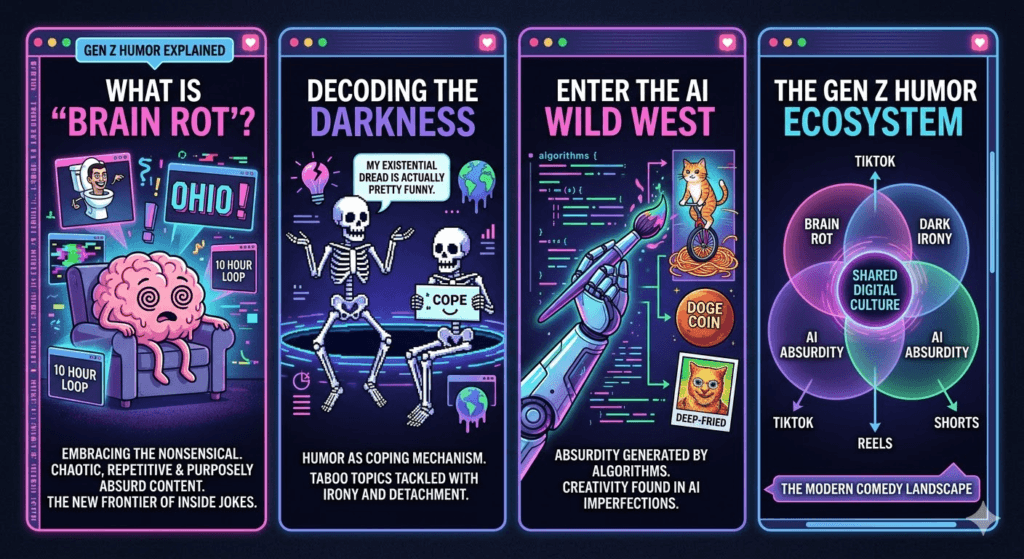
The Rise of ‘Brain Rot’: Embracing the Nonsensical
One of the most defining characteristics of current Gen Z humor is the concept of “brain rot.” Far from a medical condition, in this context, it refers to content that is intentionally nonsensical, chaotic, and almost hypnotic in its absurdity. It’s the digital equivalent of visual and auditory overload, designed to grab and hold dwindling attention spans.
The epitome of this trend is undoubtedly Skibidi Toilet. What started as a surreal YouTube short featuring a human head inside a toilet, singing a distorted version of a mashup song, morphed into a sprawling, intricate (and bizarre) narrative universe with millions of dedicated viewers. Its popularity isn’t based on clever wordplay or relatable situations; it’s purely about the sheer, baffling absurdity of the visual.
But “brain rot” goes beyond specific characters. It’s often a style – rapid-fire editing, distorted audio, saturation pumped to the max, and a relentless barrage of seemingly unrelated images and sounds. Think of compilation videos where snippets of unrelated clips are mashed together, sometimes with layered audio and distorted visuals. These might include random sound effects, distorted voices, and quick cuts between completely different scenarios. The “rot” isn’t just in the content; it’s a reflection of the fast-paced, sometimes overwhelming digital landscape Gen Z navigates, processed into a shared comedic language. It’s humor born from information overload, embracing the chaos rather than trying to make sense of it.
Finding Humor in the Void: Dark Jokes and Irony
Beyond the colorful chaos of brain rot, there’s another, significantly edgier side to Gen Z humor. It’s marked by a distinct vein of dark humor and pervasive irony, a style that can sometimes seem jarring to those unfamiliar with its nuances. This brand of comedy often dances on the edge of sensitivity, tackling themes of mortality, mental health struggles, and existential dread with a dismissive or even celebratory chuckle.
This isn’t necessarily a manifestation of cruelty; rather, it’s frequently used as a coping mechanism. Growing up in an era marked by economic instability, environmental anxiety, and constant exposure to global crises via social media, Gen Z faces unique pressures. Turning these anxieties into jokes, however dark, can be a way of reclaiming control, building shared understanding, and processing complex emotions.
This dark humor often goes hand-in-hand with heavy layers of irony. Gen Z is incredibly media-savvy and quick to spot insincerity or cliché. As a result, many memes are structured ironically – they mock the very formats they adopt, or present an opinion so exaggeratedly that the intended meaning is the exact opposite. Navigating this ironic landscape can be tricky, as the humor relies heavily on cultural context and an understanding of the specific layers of detachment at play. It’s often “meta-humor,” commenting on humor itself.
The AI Wild West: Absurdity Generated by Algorithms
The most recent addition to the Gen Z comedic toolkit is artificial intelligence. As generative AI tools for images, videos, and text become more accessible, they’ve been adopted enthusiastically by creators looking for the next level of absurdity. This has birthed a new subgenre: AI-generated humor.
This style thrives on the unexpected and the slightly-off-kilter results that AI often produces. It might involve prompting an AI image generator to create “Barack Obama fighting a dinosaur with a lightsaber in a grocery store,” leading to surreal and often flawed interpretations. Or it could be using text generators to write nonsensical scripts or generate bizarre recipes.
A popular format is the “AI generated story,” where users ask tools like ChatGPT to write stories in the style of, say, a gothic horror novel about a misplaced pair of socks. The humor comes from the AI’s literal interpretations, its tendency toward repetitive phrasing, and its frequent inability to grasp subtle human nuance, resulting in something profoundly weird yet undeniably funny. The imperfections and unpredictability are the core of the joke. This is humor derived from the machine itself, often highlighting the gaps between AI capabilities and human expectation in bizarrely creative ways.
Cracking the Code
Gen Z humor might seem like an impenetrable code to outsiders, but it’s a dynamic, evolving language. It’s a blend of digital native sensory experiences (brain rot), coping mechanisms for real-world anxieties (dark humor/irony), and playful experimentation with cutting-edge tech (AI absurdity). While specific memes and references will fade, these underlying themes and styles are likely to shape digital humor for years to come. Understanding them isn’t just about getting the joke; it’s about gaining insight into how a generation processes, interacts with, and laughs at the world around them.
Gen Z humor is confusing on purpose. It’s chaotic, fast-moving, layered with irony, and often feels like it makes no sense—until you realize that that’s the point. If you’ve ever scrolled through TikTok or Instagram Reels and thought, “What did I just watch?”, you’ve already encountered the essence of Gen Z comedy.
This guide breaks down the core pillars of Gen Z humor—“brain rot,” dark humor, and AI absurdity—and explains why this style is dominating internet culture in 2026.
What Is Gen Z Humor?
Gen Z humor is a form of post-ironic, hyper-digital comedy shaped by:
- Constant content consumption
- Meme evolution at extreme speed
- Cultural burnout and information overload
- A deep familiarity with internet language
Unlike traditional humor, Gen Z comedy often:
- Rejects structure and punchlines
- Thrives on randomness and anti-logic
- Mixes sincerity with heavy irony
It’s not meant to be universally understood—it’s meant to be felt in the moment.
1. “Brain Rot” Humor: When Content Becomes Chaos
What Is “Brain Rot”?
“Brain rot” refers to content so overstimulating, repetitive, or absurd that it feels like it’s melting your brain—yet you keep watching.
Key Characteristics:
- Loud, glitchy audio
- Rapid jump cuts
- Random memes stitched together
- No clear narrative or payoff
- Overuse of internet sound effects
Example Formats:
- A video starts with a cat, cuts to a subway clip, then ends with distorted text and screaming audio
- Repetitive phrases like “skibidi,” “gyatt,” or nonsense words with no meaning
Why It Works:
- It mirrors how Gen Z consumes content: fast, fragmented, endless
- It taps into dopamine loops—quick hits of stimulation
- It embraces the idea that nothing needs to make sense anymore
Insight: Brain rot humor is essentially algorithm-optimized chaos—designed to stop scrolling, not tell a story.
2. Dark Humor: Coping Mechanism Meets Comedy
What Defines Gen Z Dark Humor?
Gen Z’s dark humor goes beyond edgy jokes—it reflects:
- Anxiety about the future
- Economic pressure
- Climate concerns
- Digital burnout
Instead of avoiding heavy topics, Gen Z turns them into jokes.
Common Themes:
- Existential dread (“We’re all just NPCs anyway”)
- Work burnout (“9–5? I barely survived 9–9”)
- Mental health memes
- Ironic hopelessness
Tone Shift:
Unlike older generations, Gen Z delivers dark humor with:
- A flat, deadpan tone
- Minimal emotional reaction
- A mix of sincerity and irony
Why It Resonates:
- Humor becomes a coping strategy
- It creates a sense of shared struggle
- It normalizes difficult conversations
Important Note: While it can seem nihilistic, most Gen Z humor isn’t about giving up—it’s about processing reality through satire.
3. AI Absurdity: When Machines Become Comedians
The Rise of AI-Generated Humor
AI tools have unlocked a new category of humor: unpredictable, surreal, and often unintentionally hilarious content.
What AI Absurdity Looks Like:
- AI-generated voices narrating ridiculous scenarios
- Deepfake-style edits with bizarre outcomes
- Random image mashups that feel like dreams
- Fake “motivational” speeches that spiral into nonsense
Why It’s Funny:
- AI lacks human logic, creating unexpected combinations
- It amplifies randomness beyond human creativity
- It feels uncanny—almost real, but slightly “off”
Viral Formats:
- “AI explaining something incorrectly with confidence”
- “AI-generated history that never happened”
- Absurd fake ads or movie trailers
Key Insight: AI humor thrives on the gap between what should make sense and what doesn’t.
4. The Role of Irony (and Post-Irony)
Gen Z humor operates on multiple layers:
| Layer | Meaning |
|---|---|
| Irony | Saying the opposite of what you mean |
| Meta-Irony | Joking about the joke itself |
| Post-Irony | Blurring sincerity and irony completely |
At any moment, a Gen Z joke might be:
- Completely serious
- Completely ironic
- Both at the same time
This ambiguity is intentional—it keeps the audience engaged and guessing.
5. Why Gen Z Humor Feels “Hard to Understand”
If you don’t get it immediately, that’s normal. Gen Z humor depends on:
- Context: You need to know the meme history
- Speed: Trends evolve in days, not months
- Platform culture: TikTok humor ≠ Twitter humor ≠ YouTube humor
It’s less like a traditional joke and more like a shared language among digital natives.
6. How Algorithms Shape Gen Z Humor
Platforms like TikTok, Instagram, and YouTube Shorts reward:
- High watch time
- Quick engagement
- Emotional reactions (even confusion)
As a result, humor has evolved to be:
- Shorter
- More chaotic
- More attention-grabbing
Translation: The algorithm doesn’t care if content makes sense—it cares if you don’t scroll past it.
7. How Brands and Creators Are Using It
Smart creators and brands are adapting Gen Z humor to grow fast.
Winning Strategies:
- Embrace absurdity instead of polished messaging
- Use self-aware, ironic tones
- Jump on trends early (speed matters more than perfection)
- Don’t over-explain the joke
Risk:
Trying too hard to be “relatable” can backfire. Gen Z quickly detects:
- Forced humor
- Outdated memes
- Corporate tone disguised as casual
Rule: If it feels like marketing, it’s already failing.
8. The Psychology Behind It All
Gen Z humor reflects deeper behavioral patterns:
- Information overload → Chaos humor
- Stress and uncertainty → Dark humor
- Tech immersion → AI humor
This isn’t random—it’s a mirror of digital life.