The landscape of blogging is constantly shifting, and what worked in 2021, 2023, or even 2025 may not be effective today. If you’re looking to start or grow a blog in 2026, you’re entering a world that is more saturated, yet more sophisticated than ever. The core principles of creating great content remain, but the how and the where have fundamentally changed.
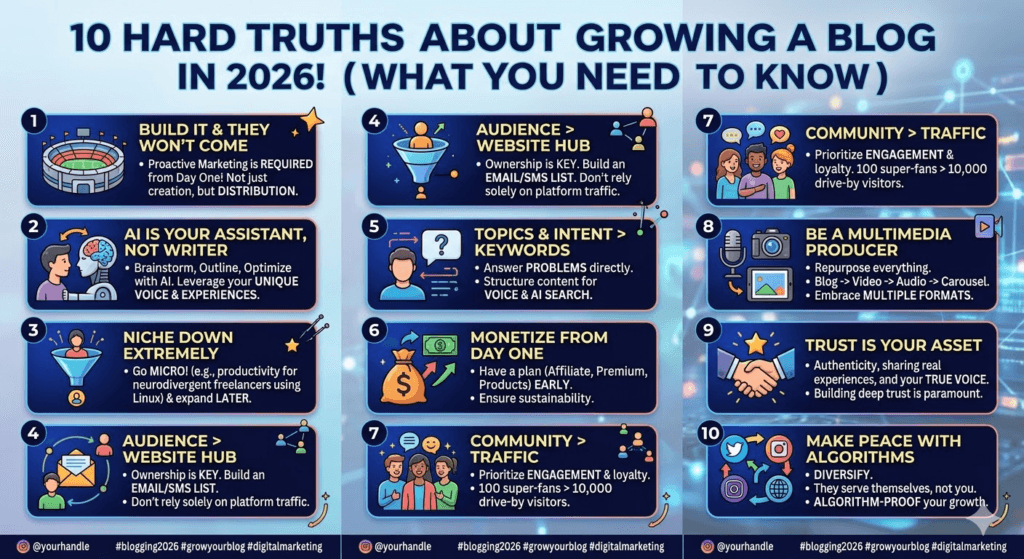
Looking back, there are things I wish I’d understood earlier about the specific nuances of building a blog in this current climate. Whether you’re a complete beginner or a seasoned blogger trying to adapt, here are 10 things I wish I knew before trying to grow a blog in 2026.
1. “Build It and They Will Come” is Long Dead (Seriously)
There was a time, perhaps a decade ago, where simply writing good content and optimizing for a few keywords could get you organic traffic. In 2026, the internet is not just crowded, it’s intelligently organized. You cannot rely solely on the quality of your writing.
The Lesson: You need a proactive, multifaceted marketing strategy from day one. Great content is the prerequisite, not the finish line. Distribution is just as important as creation. Your blog is a product, and like any product, it requires active promotion across multiple channels.
2. Artificial Intelligence is Not Your Enemy, it’s Your Junior Assistant
By 2026, AI tools for writing, SEO, and content distribution are mature and ubiquitous. Many bloggers initially feared that AI would replace them. The truth is more nuanced.
The Lesson: Learn to collaborate with AI, not compete against it. Use AI for brainstorming, structuring outlines, optimizing for SEO, and generating social media copy. However, do not let it write your core content. Your unique perspective, personal voice, and lived experiences are your only truly irreplicable competitive advantage. The future belongs to those who use AI to become faster and smarter, not lazy.
3. The “Niche Down” Advice Got Extreme
“Find your niche” has been the mantra for decades. In 2026, the “niches” are incredibly micro. You can’t just be a “tech blogger.” You need to be a “tech blogger specifically focusing on productivity apps for neurodivergent freelancers using Linux.”
The Lesson: Go incredibly narrow to start. The broader your topic, the stiffer the competition and the harder it is to establish authority. Once you’ve dominated that micro-niche, you can slowly expand to adjacent topics. This approach allows you to build a hyper-loyal community that trusts you as a specific expert.
4. Your Blog is NOT Your Hub; Your Audience is
In the past, the goal was to drive every piece of traffic back to your website (the “hub”). The 2026 landscape is platform-agnostic. Your audience might find your content as a TikTok, a Substack email, a thread on a decentralized social network, or as a traditional blog post.
The Lesson: The “blog” as a website is merely one place your content lives. Your goal is to own the relationship with your audience, not just the domain. Focus on building an email list or SMS list. This gives you direct access to your audience, regardless of whether Google or a social algorithm decides to demote your website.
5. The Death of Traditional Keywords (and the Rise of Search Intent)
In 2026, typing a single keyword into a search engine (if we still use them the same way) is less common than asking complex questions through voice or AI-powered assistants. Standard SEO based solely on “high-volume, low-competition keywords” is increasingly outdated.
The Lesson: Shift your focus from keywords to topics and search intent. What problem is the user trying to solve when they search for a term? Structure your content to provide the most comprehensive, direct, and multi-format answer to that problem.
6. Monetization from Day One is a Viable (and Necessary) Goal
The old advice was, “Build your audience, and then figure out monetization later.” In 2026, with the cost of tools and distribution, that’s a risky path. You cannot afford to treat your blog as a “hobby” if you intend for it to be sustainable.
The Lesson: Have a monetization plan (or at least hypotheses) from the start. Understand how you might monetize, whether through affiliate marketing, premium content (like a Substack), specialized consulting, digital products, or high-value services. Building monetization into your strategy early ensures you are creating a viable business model, not just a publishing platform.
7. Community is More Important than Traffic
You might get 10,000 visitors, but if they click once and never return, your blog is not growing. A healthy blog is about engagement, not just vanity metrics. In 2026, an audience is passive; a community is active.
The Lesson: Prioritize depth over breadth. One hundred dedicated fans who participate in your comment section, open every email, and share your work are infinitely more valuable than 10,000 anonymous fly-by visitors. Build mechanisms for community interaction (like a Discord, specialized forum, or even a robust comment section).
8. You Need to be a Multimedia Producer
Writing is fantastic, but in 2026, a text-only blog is at a major disadvantage. Your audience consumes content in various formats. They want to read, listen, and watch.
The Lesson: Repurpose everything. A single blog post should also become a 60-second TikTok/Reels clip, a 10-slide Instagram carousel, a short-form audio snippet (perhaps a podcast “chapter”), and potentially a thread on a platform like X or Threads. If you are not comfortable with video or audio, 2026 is the year to get comfortable.
9. Trust and Authenticity are Your Most Valuable Assets
In an internet flooded with AI-generated, “optimized” content, what is genuinely true becomes the rarest commodity.
The Lesson: Do not try to be “perfect.” Authenticity, sharing your failures, your true opinions (even if they’re controversial in your niche), and your unique voice is what builds deep trust. Trust is the foundation of community and the primary reason people will choose your content (and potentially your recommendations or products) over an AI summary.
10. The Algorithm is Still Not Your Friend (But You Have to Make Peace with It)
Social media algorithms and search algorithms (whatever form they take in 2026) are not designed to help you. They are designed to keep the user on their platform.
The Lesson: Treat algorithms like the weather. You cannot control them, but you must prepare for them. Diversify. Never rely on a single platform for more than 50% of your traffic. Building that direct line to your audience (see point #4) is the only way to “algorithm-proof” your blog.
Final Thoughts
Growing a blog in 2026 is a significant challenge, but it is far from impossible. It requires a strategic pivot from “content creation” to “media company operation.” By embracing these lessons and understanding the new rules of the game, you can build a vibrant, sustainable, and highly engaged community around your expertise and passion. The tools are more powerful than ever; the potential is still there—you just need a 2026-era blueprint.