Introduction
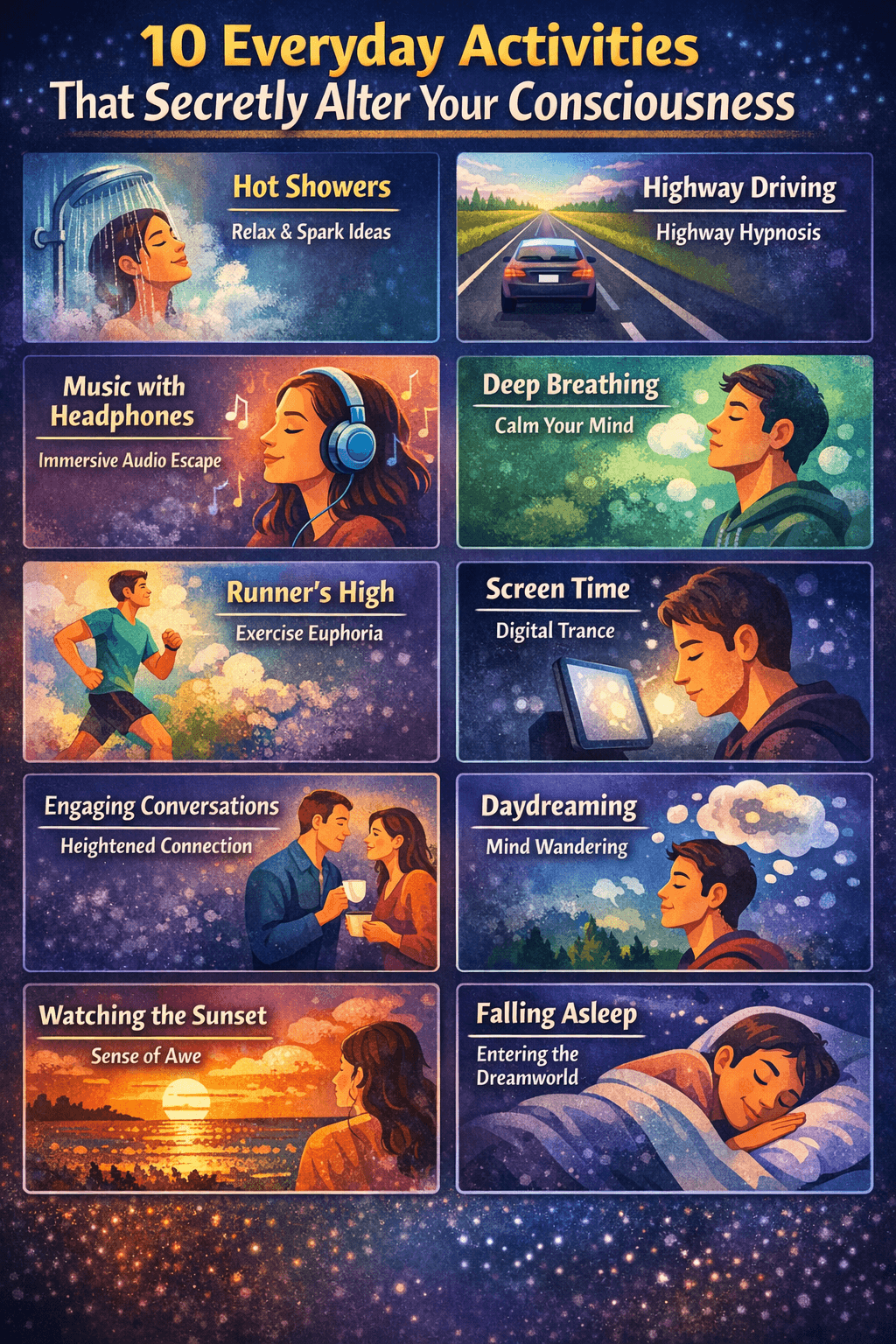
We usually think of altered states of consciousness as something reserved for meditation retreats, psychedelic adventures, or extreme rituals. But the reality is far more ordinary. Your brain is constantly tweaking its own settings, and many of the things you do every day—without thinking twice—can nudge it into flow states, mild euphoria, distorted time perception, or even subtle hallucinations. These shifts are often brief, harmless, and built right into human biology. Here are ten surprisingly common activities that are secretly rewiring your awareness more than you realize.
Most people associate altered states of consciousness with meditation retreats, psychedelic substances, or extreme spiritual practices.
But neuroscience suggests something surprising: ordinary daily activities can subtly shift your awareness, perception, and brain chemistry.
From the moment you wake up to the time you fall asleep, your brain constantly changes states—moving between focus, relaxation, creativity, and dreamlike awareness. Many seemingly simple habits can temporarily reshape how you perceive the world.
Here are 10 everyday activities that quietly alter your consciousness—often without you realizing it.
10. Taking a Hot Shower
A hot shower does more than clean your body—it can shift your mental state.
Warm water stimulates blood flow and activates the parasympathetic nervous system, which helps the body relax. As tension melts away, many people experience a mild trance-like calmness.
This is why creative ideas often appear in the shower. Your brain transitions into a relaxed “default mode network,” a state linked to daydreaming and creative insight.
9. Long-Distance Driving
Have you ever arrived somewhere and barely remembered the drive?
Psychologists call this phenomenon “highway hypnosis.” During repetitive driving, your brain switches to an automated mode where conscious awareness fades and muscle memory takes over.
In this state, your brain remains alert enough to drive safely, but your conscious attention drifts elsewhere, producing a mild altered state.
8. Listening to Music with Headphones
Music is one of the most powerful consciousness-altering tools humans use daily.
Certain rhythms and melodies influence brainwave patterns, shifting them toward relaxed alpha waves or focused beta waves. This is why music can make you feel energized, emotional, nostalgic, or deeply calm.
With headphones, the effect intensifies because your brain becomes immersed in an auditory environment, temporarily detaching from surrounding reality.
7. Deep Breathing
You don’t need meditation training to alter your consciousness—sometimes just breathing slowly can do it.
Controlled breathing changes oxygen and carbon dioxide levels in the bloodstream and activates the vagus nerve. The result is a rapid shift in mental state from stress to calm.
Even a few minutes of slow breathing can create a meditative awareness similar to light trance states.
6. Exercise “Runner’s High”
Many runners describe a moment during intense exercise where fatigue disappears and they feel euphoric or mentally clear.
This phenomenon, known as a runner’s high, occurs when the brain releases endorphins and endocannabinoids during prolonged physical activity.
These chemicals create mild euphoria and sometimes a dreamlike sense of time distortion.
5. Staring at Screens for Long Periods
Scrolling social media or binge-watching shows can quietly shift consciousness into a passive, hypnotic attention state.
Your brain becomes highly focused on rapidly changing visual stimuli, while awareness of your surroundings fades.
This “digital trance” is why people often lose track of time after hours of scrolling or streaming content.
4. Intense Conversations
Ever been so absorbed in conversation that you forgot everything else around you?
Deep social interactions trigger strong emotional and cognitive engagement. When people exchange stories, laughter, or debates, the brain releases dopamine and oxytocin.
This combination can create a heightened state of awareness and emotional connection, temporarily reshaping your perception of reality.
3. Daydreaming
Daydreaming may seem like mental laziness, but it actually involves a unique brain state.
When your mind wanders, the default mode network activates—a system associated with imagination, self-reflection, and creativity.
In this state, consciousness turns inward, allowing the brain to explore possibilities, simulate future scenarios, and generate new ideas.
2. Watching the Sunset
Few everyday experiences feel as powerful as watching the sun disappear over the horizon.
Natural beauty often triggers a psychological response known as “awe.” Researchers have found that awe can slow perceived time and reduce self-focused thinking.
For a moment, your mind shifts into a broader, more reflective awareness of the world.
1. Falling Asleep
The most common altered state of consciousness happens every single night.
As you fall asleep, your brain transitions through several stages—moving from wakefulness into light sleep, deep sleep, and eventually dreaming.
During this process, your brain waves slow dramatically and your perception of reality dissolves. Dreams then create entire worlds generated by the mind itself.
Important Thoughts
Altered states of consciousness aren’t rare or mystical—they happen constantly throughout daily life.
From listening to music to driving long distances, the brain shifts between different awareness modes dozens of times each day. These subtle changes shape how we think, feel, and experience reality.
The fascinating part? Most of us move through these states without even noticing.
And once you start paying attention, you may realize that ordinary life is full of small, mind-bending moments.