Artificial Intelligence is transforming industries faster than any technology in modern history. From healthcare and finance to marketing and software development, AI is becoming a core component of how businesses operate.
As AI adoption accelerates, professionals who understand how to work with AI—not compete against it—will dominate the future job market. Studies show that AI-related skills significantly increase hiring chances and career opportunities across industries.
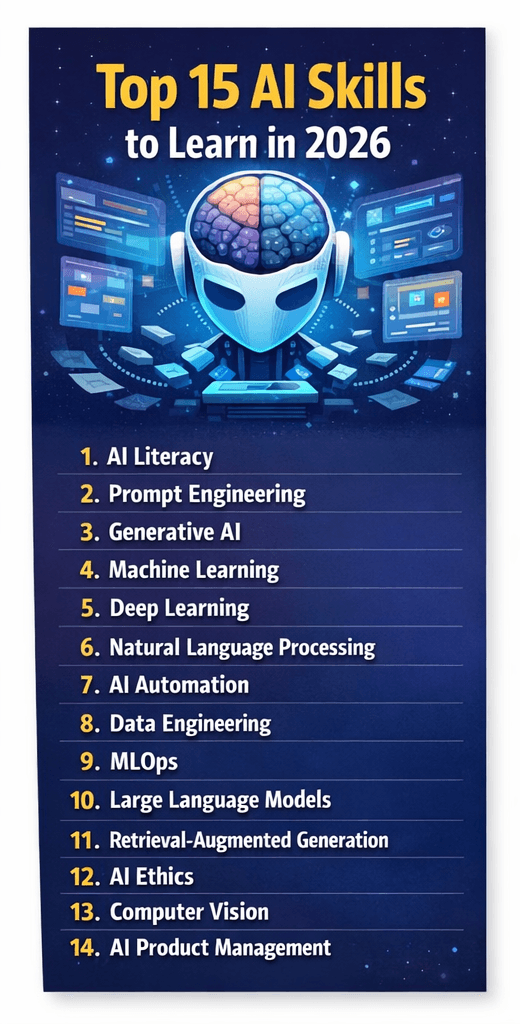
If you want to future-proof your career, here are the 15 most important AI skills you must learn in 2026.
1. AI Literacy (Understanding How AI Works)
Before mastering advanced AI tools, you must understand the basics.
AI literacy means knowing:
- How AI models work
- Their strengths and limitations
- Where AI should or shouldn’t be used
Professionals who understand AI fundamentals can make smarter decisions when integrating AI into business workflows.
Key topics to learn:
- Artificial Intelligence fundamentals
- Machine learning basics
- Data-driven decision making
2. Prompt Engineering
Prompt engineering is one of the fastest-growing AI skills today.
It involves crafting structured prompts to get better results from AI models like ChatGPT, Claude, or Gemini.
Good prompts can dramatically improve AI outputs for:
- Content writing
- Coding
- Research
- Data analysis
Companies increasingly seek professionals who know how to communicate effectively with AI systems.
3. Generative AI
Generative AI powers modern tools that create:
- Text
- Images
- Videos
- Code
- Music
Learning generative AI helps professionals build applications like:
- AI chatbots
- automated content tools
- AI marketing systems
Businesses rely on generative AI to automate content production and customer engagement.
4. Machine Learning
Machine learning is the backbone of artificial intelligence.
It enables systems to learn from data and improve automatically without explicit programming.
Key areas include:
- Supervised learning
- Unsupervised learning
- Model evaluation
- Feature engineering
Machine learning engineers are among the highest-paid professionals in AI.
5. Deep Learning
Deep learning powers modern AI breakthroughs like:
- Image recognition
- voice assistants
- self-driving cars
- large language models
This skill involves working with neural networks such as:
- CNNs
- RNNs
- Transformers
Deep learning skills appear in over 28% of AI job postings, making it one of the most demanded technical competencies.
6. Natural Language Processing (NLP)
NLP allows machines to understand human language.
Applications include:
- Chatbots
- sentiment analysis
- translation tools
- AI writing assistants
NLP is one of the most requested AI skills in the job market, appearing in nearly 20% of AI-related job listings.
7. AI Automation & Workflow Design
AI is not just about building models — it’s about automating real business workflows.
Examples include:
- AI-powered customer support
- automated marketing campaigns
- workflow automation tools
Learning to connect AI with business processes dramatically increases productivity.
8. Data Engineering
AI systems depend heavily on data.
Data engineering focuses on:
- collecting data
- cleaning datasets
- building pipelines
- managing large data systems
Without high-quality data, even the best AI models fail.
9. MLOps (Machine Learning Operations)
MLOps is the process of deploying and managing AI models in real-world applications.
It includes:
- model deployment
- monitoring
- scaling
- version control
Companies need professionals who can take AI models from experimentation to production.
10. Large Language Models (LLMs)
Large Language Models like GPT systems are driving the current AI revolution.
Skills to learn:
- LLM architecture
- fine-tuning models
- prompt optimization
- building LLM applications
Many modern AI applications—from search engines to coding assistants—are powered by LLMs.
11. Retrieval-Augmented Generation (RAG)
RAG systems combine AI models with external knowledge sources.
This allows AI tools to:
- access private databases
- answer company-specific questions
- reduce hallucinations
RAG is becoming a core architecture for enterprise AI applications.
12. AI Ethics and Responsible AI
As AI adoption grows, ethical concerns are increasing.
Organizations now require experts who understand:
- bias in AI systems
- transparency
- responsible AI governance
- privacy regulations
Responsible AI is one of the fastest-growing AI skill areas globally.
13. Computer Vision
Computer vision enables machines to interpret images and videos.
Applications include:
- facial recognition
- autonomous vehicles
- medical imaging
- security surveillance
This skill is especially valuable in industries like healthcare and robotics.
14. AI Product Management
AI products require professionals who understand both technology and business strategy.
AI product managers focus on:
- defining AI product vision
- managing AI development teams
- aligning AI features with business goals
This role is becoming increasingly important as companies build AI-powered platforms.
15. Human + AI Collaboration Skills
One of the most underrated AI skills is learning how to collaborate with AI systems.
Key abilities include:
- critical thinking
- verifying AI outputs
- problem framing
- decision-making
Experts say the future workforce will consist of professionals who combine human creativity with AI intelligence.
Important Thoughts
AI is no longer just a niche technical field — it’s becoming a core skill set for nearly every profession.
Professionals who learn how to:
- build AI systems
- integrate AI into workflows
- collaborate effectively with AI
will dominate the next decade of innovation.
The good news? You don’t need to master everything at once.
Start with AI literacy, prompt engineering, and generative AI, then gradually expand into advanced areas like machine learning, MLOps, and LLM development.
The sooner you start learning these skills, the better positioned you’ll be in the AI-powered future.