Artificial Intelligence (AI) is no longer a futuristic concept — it has become the backbone of the modern internet. From personalized content feeds to automated customer service, AI is reshaping how people interact online. Social media platforms, search engines, and digital marketing strategies are all evolving rapidly thanks to powerful AI technologies.
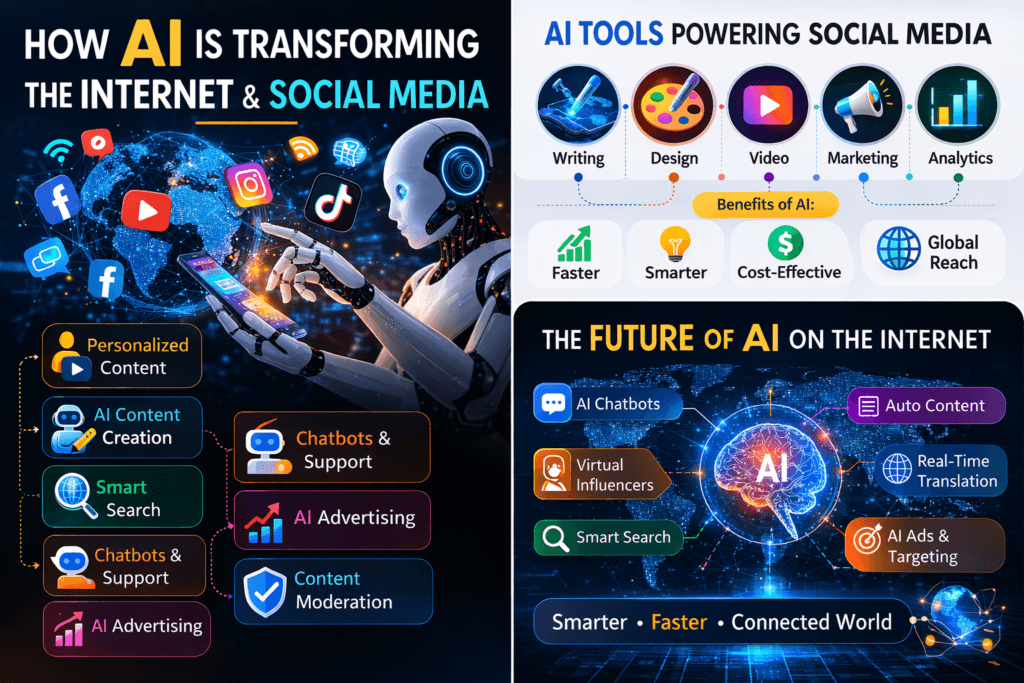
Companies like OpenAI, Google, Meta Platforms, and Microsoft are investing billions into AI development, transforming the digital world faster than ever before.
In March 2026, the internet and social media feel fundamentally different from just a few years ago. Algorithms no longer simply recommend content—they anticipate desires, generate experiences, and even converse in real time. Generative AI has flooded feeds with personalized visuals, videos, and replies, while agentic systems handle interactions that once required human teams. Search itself is shifting: many users, especially Gen Z, now turn to AI chatbots instead of traditional engines for discovery.
This isn’t incremental change—it’s a full rewiring of how we connect, consume, create, and trust online. Here’s everything happening right now and why it matters.
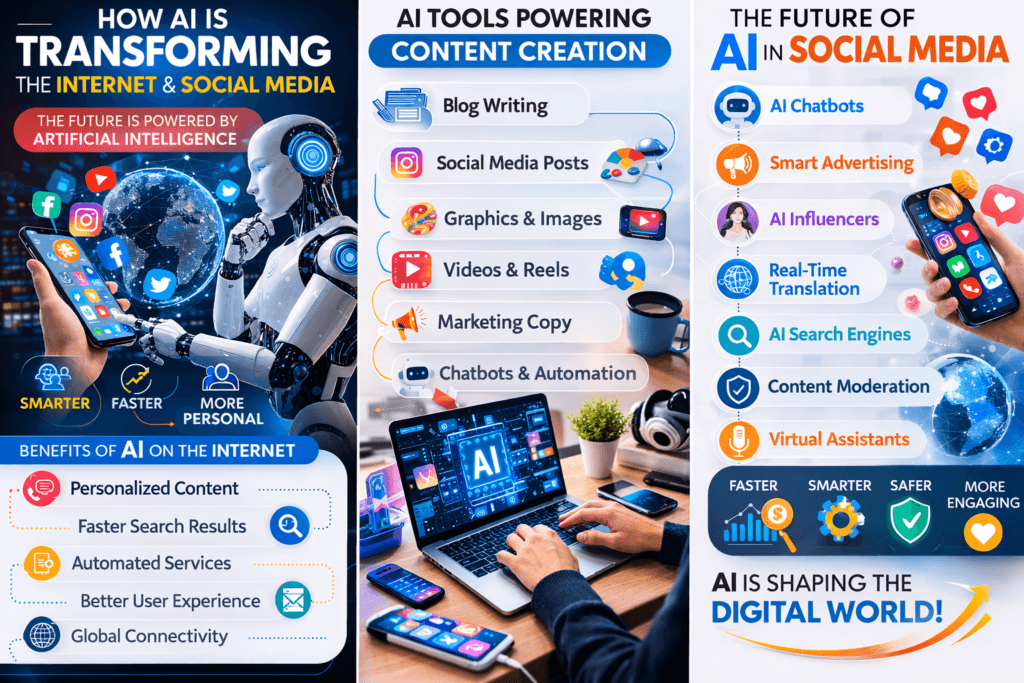
IIn this article, we’ll explore how AI is revolutionizing the internet and social media — and what the future may look like.
1. Personalized Content Feeds
One of the most visible impacts of AI is personalized content recommendations. Social media platforms use machine learning algorithms to analyze user behavior, interests, and engagement patterns.
Platforms like:
- TikTok
- YouTube
use AI to determine what content appears in your feed.
For example:
- Videos you watch
- Posts you like or comment on
- Accounts you follow
- Topics you search for
AI systems analyze this data to show highly relevant content, increasing user engagement and time spent on platforms.
2. AI-Powered Content Creation
AI tools are making it easier than ever to create high-quality content for blogs, social media, and marketing campaigns.
Popular AI tools include:
- ChatGPT for writing content
- Canva for AI design and graphics
- Grammarly for writing assistance
Content creators now use AI to generate:
- Blog posts
- Social media captions
- Images and graphics
- Videos
- Marketing copy
This allows creators and businesses to produce more content in less time, dramatically increasing productivity.
3. Smarter Search Engines
Search engines have become much smarter thanks to AI.
For example, Google uses AI systems such as:
- Natural language processing
- Machine learning algorithms
- AI-powered ranking systems
These technologies help search engines understand user intent, not just keywords.
This means search results are now:
- More accurate
- More personalized
- More relevant
AI-powered search assistants are also emerging, allowing users to get direct answers instead of browsing multiple websites.
4. AI Chatbots and Customer Support
Many websites now use AI chatbots to handle customer inquiries instantly.
Companies integrate AI chat systems to:
- Answer frequently asked questions
- Provide product recommendations
- Solve customer problems
- Offer 24/7 support
Businesses using AI chatbots can significantly reduce customer service costs while improving response times.
Platforms powered by technologies from companies like OpenAI and Microsoft are helping businesses automate large parts of customer interaction.
5. AI Moderation and Content Safety
Social media platforms receive millions of posts every hour, making manual moderation impossible.
AI helps detect and remove:
- Spam content
- Fake accounts
- Hate speech
- Violent or harmful posts
Companies like Meta Platforms rely heavily on AI systems to keep platforms safer and enforce community guidelines.
AI moderation systems can analyze text, images, and videos within seconds.
6. Influencer Marketing Powered by AI
AI is transforming how brands work with influencers.
Advanced AI tools can now:
- Identify trending creators
- Analyze engagement quality
- Predict campaign performance
- Detect fake followers
Brands can make data-driven decisions when choosing influencers for marketing campaigns.
This has made influencer marketing more efficient and measurable.
7. AI-Generated Images and Videos
Another major transformation is the rise of AI-generated media.
AI tools can now create:
- Realistic images
- Social media graphics
- Short videos
- Digital avatars
These technologies allow creators to produce professional visuals without expensive equipment or design skills.
However, AI-generated media also raises concerns about deepfakes and misinformation, which is becoming a growing challenge for platforms.
8. Advanced Social Media Advertising
AI has revolutionized digital advertising.
Advertising platforms from companies like Google and Meta Platforms use AI to optimize ad campaigns automatically.
AI helps advertisers:
- Target the right audience
- Optimize ad spending
- Improve click-through rates
- Increase conversions
AI systems continuously analyze data and adjust campaigns in real time for better performance.
9. Real-Time Language Translation
AI is also breaking language barriers on the internet.
AI-powered translation tools allow users to communicate globally without language limitations.
For example, translation systems integrated into platforms like YouTube and Facebook allow posts and videos to reach audiences worldwide.
This technology is making the internet more connected and accessible than ever.
10. The Future of AI on the Internet
The role of AI on the internet will only grow stronger in the coming years.
Future developments may include:
- Fully AI-generated websites
- AI-powered social networks
- Virtual influencers powered by AI
- Personalized AI assistants for browsing the web
Technology leaders like Elon Musk and Sam Altman believe AI will fundamentally reshape the digital ecosystem.
The internet of the future will likely be smarter, more personalized, and more automated than anything we’ve seen before.
Other Details
Artificial Intelligence is rapidly transforming the internet and social media. From personalized content feeds to automated customer service and AI-powered advertising, the digital world is becoming more intelligent every day.
While AI brings incredible opportunities for innovation and growth, it also raises important challenges related to privacy, misinformation, and ethics.
As AI continues to evolve, one thing is clear: the future of the internet will be powered by artificial intelligence.
1. Hyper-Personalized Feeds Powered by Advanced AI Algorithms
Social platforms in 2026 run on deeply intelligent recommendation engines. AI analyzes not just likes and shares, but emotional tone in comments, dwell time, cross-platform behavior, and even real-time mood signals from interactions.
- Feeds feel eerily tailored: one user’s TikTok or Instagram is almost unrecognizably different from another’s, even among similar demographics.
- Platforms prioritize “authentic” signals over pure virality—algorithms boost genuine engagement while deprioritizing low-effort AI slop (mass-produced, low-quality generative content that floods feeds and erodes trust).
- Result: higher retention for users, but also algorithmic burnout—some feel overwhelmed by perfectly optimized content that leaves little room for serendipity or challenge.
Brands adapt by blending AI prediction with human creativity to cut through the noise.
2. Generative AI Content Creation at Industrial Scale
By 2026, businesses generate nearly half (around 48%) of their social media content using generative AI—up from about 39% in recent years. Tools create:
- Captions, hashtags, and full posts in brand voice
- Short-form videos (Reels, TikTok-style clips) from text prompts or existing assets
- Carousels, thumbnails, and interactive formats
- Variants for A/B testing across platforms
Creators repurpose long-form content instantly: a podcast episode becomes TikTok hooks, LinkedIn threads, Instagram stories, and X threads—all AI-assisted in minutes.
The flip side? Feeds fill with synthetic media. Platforms now label or downrank obvious low-effort AI output, and users increasingly crave human authenticity—leading to a premium on “human-first” creators.
3. AI Agents as the New Frontline of Interaction
AI agents have become the default for customer service, community management, and even influencer-style engagement.
- Real-time replies handle complex queries 24/7 with context from past interactions.
- Agents moderate comments, flag misinformation, and nurture leads autonomously.
- Some brands deploy multi-agent teams: one researches trends, another drafts responses, a third analyzes sentiment.
This scales support dramatically—but raises questions about authenticity. When every brand reply feels polished and instant, human touch becomes a differentiator.
4. The Blurring Line Between Real and Synthetic Media
Deepfakes, AI-generated images, videos, and audio are now routine, cheap, and scalable.
- Whimsical memes mix with harmful disinformation, political manipulation, and fraud attempts.
- Platforms roll out better detection and watermarking, but erosion of trust accelerates—”Can we believe anything anymore?” becomes a common sentiment.
- On the positive side, generative tools democratize creation: anyone makes professional-grade visuals or edits without expensive software.
The internet in 2026 demands new literacy: verifying sources, spotting synthetic artifacts, and valuing provenance.
5. Search and Discovery: From Google to AI Assistants
A growing share of users—especially younger ones—bypass traditional search for AI chatbots that summarize, synthesize, and recommend directly.
- Queries like “best hiking spots near Beech Grove, Indiana” return curated plans with maps, reviews, and personalized tips instead of link lists.
- Social platforms integrate AI search: X trends, Instagram explore, and TikTok For You become proactive discovery layers powered by multimodal reasoning.
- This reduces click-through to websites, pressuring publishers while giving platforms even more control over information flow.
The broader internet shifts toward AI-mediated experiences rather than page-based browsing.
6. Challenges: Trust, Burnout, and the Dead Internet Theory
Not everything is utopian.
- AI slop and bot-driven engagement create feedback loops where metrics inflate artificially, making real reach harder.
- Users report algorithmic burnout—feeds feel addictive yet exhausting.
- Privacy concerns rise as AI trains on ever-more personal data.
- The “Dead Internet Theory” gains renewed discussion: if much online activity is AI-generated or bot-amplified, is the web still human?
Regulations tighten in some regions, pushing platforms toward transparency in AI labeling and algorithmic choices.
Looking Ahead: The Human-AI Balance Defines the Future
In 2026, AI isn’t just enhancing the internet and social media—it’s becoming the operating system.
The winners? Those who use AI as infrastructure while preserving human judgment, creativity, and authenticity:
- Creators who blend tools with personal voice stand out.
- Brands that deploy agents thoughtfully build deeper trust.
- Users who master AI literacy navigate the noise better.
The internet remains a place of connection, but now it’s co-created by humans and machines. The transformation isn’t slowing—it’s accelerating.
How has AI changed your own social media experience lately? Have you noticed feeds feeling more (or less) human? Drop your thoughts in the comments—I’d love to hear from you, Vivek! 🚀