Artificial Intelligence (AI) and automation are no longer futuristic concepts—they are transforming workplaces around the globe. From streamlining routine tasks to taking on complex decision-making processes, AI is reshaping how we work. While these innovations promise efficiency and new opportunities, they also raise critical questions about job security and the future of work.
IIn this article, we explore 20 careers at risk due to AI and discuss what professionals can do to adapt in an era where AI replacing jobs is becoming increasingly common.
The Impact of AI on the Job Market
AI systems are designed to perform tasks that once required human intelligence, such as data analysis, language processing, and even creative problem-solving. This capability has created a significant shift in the labor market:
- Routine jobs are the most vulnerable: Positions involving repetitive, predictable tasks are more likely to be automated.
- Upskilling is critical: Jobs requiring creativity, critical thinking, and interpersonal skills are less likely to disappear.
- New opportunities emerge: AI is also creating entirely new career paths in technology, AI ethics, data science, and human-AI collaboration.
The trend is clear: the workforce must adapt to stay relevant in the age of intelligent machines.
20 Careers That May Disappear by 2035
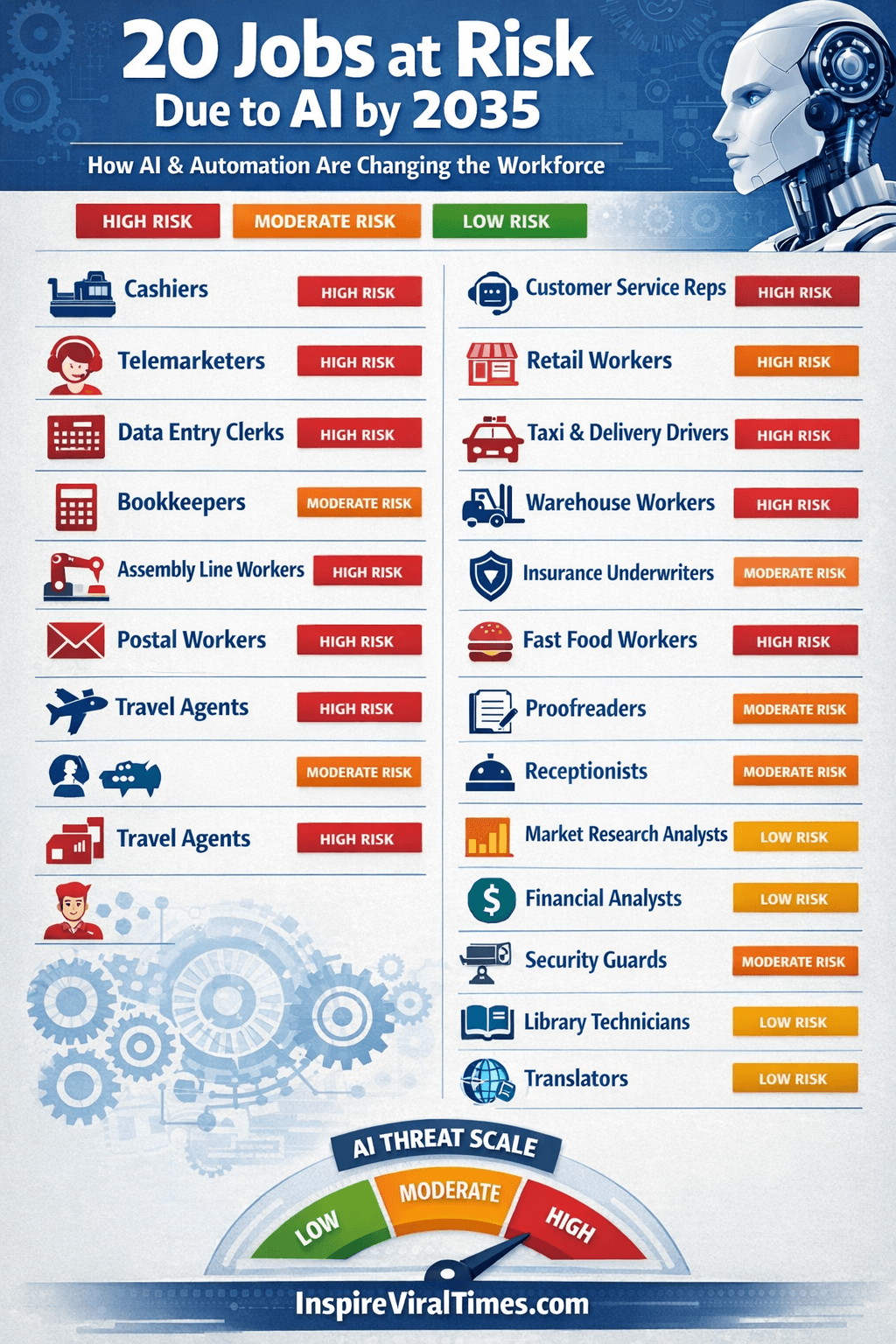
Here’s a look at the professions most at risk due to AI and automation:
- Cashiers – Automated checkout systems are reducing the need for human cashiers.
- Telemarketers – AI-driven customer interaction tools are replacing cold-calling jobs.
- Data Entry Clerks – Intelligent software can input and organize data faster and more accurately.
- Bookkeepers – AI accounting platforms handle financial records and reporting efficiently.
- Assembly Line Workers – Robotics and automated manufacturing are transforming factories.
- Postal Workers – Digital communication and AI sorting systems reduce traditional mail handling jobs.
- Travel Agents – AI booking platforms provide personalized travel recommendations instantly.
- Customer Service Representatives – Chatbots and AI-driven support systems manage common inquiries.
- Retail Workers – E-commerce automation and smart inventory systems reduce store staffing needs.
- Taxi and Delivery Drivers – Self-driving vehicles and drone delivery are on the rise.
- Warehouse Workers – Automated storage and retrieval systems optimize logistics.
- Insurance Underwriters – AI can analyze risk and process policies faster than humans.
- Fast Food Workers – Robotic chefs and kiosks streamline food preparation.
- Proofreaders – AI grammar and content analysis tools can catch errors in seconds.
- Receptionists – Virtual assistants and AI scheduling tools reduce front-desk roles.
- Market Research Analysts – AI can analyze consumer data and generate insights quickly.
- Financial Analysts – Predictive algorithms forecast market trends with high accuracy.
- Security Guards – AI surveillance systems enhance monitoring capabilities.
- Library Technicians – Digital databases and AI indexing reduce the need for manual organization.
- Translators – AI language models now provide near-instant translation for multiple languages.
Adapting to the AI Era: Skills That Will Matter
While some jobs may disappear, AI also opens the door to new opportunities. Professionals can future-proof their careers by focusing on skills that machines struggle to replicate:
- Critical thinking and problem-solving
- Emotional intelligence and interpersonal communication
- Creativity and design thinking
- Technical expertise in AI, machine learning, and data analytics
- Adaptability and lifelong learning mindset
Upskilling in these areas ensures individuals remain competitive and can leverage AI tools rather than be replaced by them.
The Future of Work
AI will undeniably continue to change the workforce landscape. While some roles may become obsolete, the evolution of work is not solely about loss—it’s about transformation. By embracing AI, upskilling, and exploring new career paths, professionals can navigate this shift successfully.
The key takeaway: AI replacing jobs does not mean the end of human work—it means a new chapter in the future of work, where collaboration between humans and intelligent systems defines success.