IIntroduction
Artificial Intelligence (AI) is no longer a futuristic concept—it is already shaping the way we live, work, and interact with technology. From voice assistants on our smartphones to recommendation systems on streaming platforms, AI has quietly become an integral part of modern life.
Over the past decade, rapid advancements in computing power, data availability, and algorithms have pushed AI from research labs into real-world applications across industries. Today, businesses, governments, and individuals are leveraging AI to solve complex problems, automate tasks, and create new opportunities.
In this article, we explore what Artificial Intelligence is, how it works, its real-world applications, benefits, challenges, and what the future holds for this revolutionary technology.
What is Artificial Intelligence?
Artificial Intelligence refers to the ability of machines and computer systems to perform tasks that normally require human intelligence. These tasks include:
- Learning from data
- Recognizing patterns
- Understanding language
- Making decisions
- Solving problems
AI systems rely on algorithms and large datasets to analyze information, learn from experiences, and improve their performance over time.
IIn simple terms, AI enables machines to think, learn, and adapt in ways similar to humans.
Key Types of Artificial Intelligence
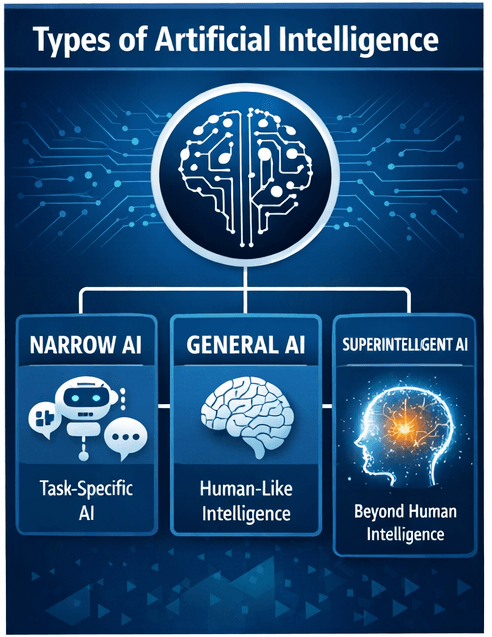
Artificial Intelligence can be broadly categorized into several types based on its capabilities.
1. Narrow AI (Weak AI)
Narrow AI is designed to perform a specific task. It is the most common form of AI used today.
Examples include:
- Voice assistants like Amazon Alexa
- Recommendation engines used by Netflix
- Self-driving features in Tesla vehicles
These systems excel at their specific functions but cannot perform tasks outside their programmed capabilities.
2. General AI (Strong AI)
General AI refers to machines that possess the ability to understand, learn, and perform any intellectual task that a human can do.
Currently, General AI remains largely theoretical and is an active area of research.
3. Superintelligent AI
This hypothetical level of AI would surpass human intelligence across all domains including creativity, problem-solving, and decision-making.
While this concept is widely discussed in scientific and philosophical circles, it has not yet been achieved.
How Artificial Intelligence Works
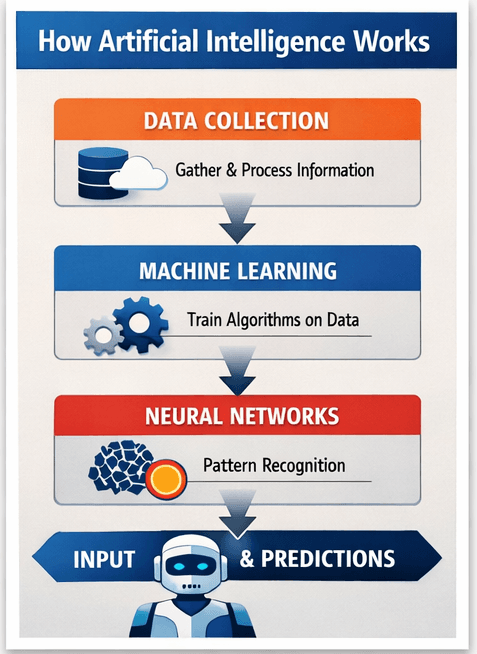
Artificial Intelligence relies on several key technologies:
Machine Learning
Machine Learning enables systems to learn from data without being explicitly programmed. Algorithms identify patterns in data and improve their performance through experience.
Deep Learning
Deep Learning uses neural networks that mimic the human brain to process large amounts of complex data such as images, speech, and text.
Natural Language Processing (NLP)
NLP allows computers to understand and generate human language. This technology powers chatbots, virtual assistants, and language translation systems.
Computer Vision
Computer Vision enables machines to interpret and understand visual information from images and videos.
Real-World Applications of AI
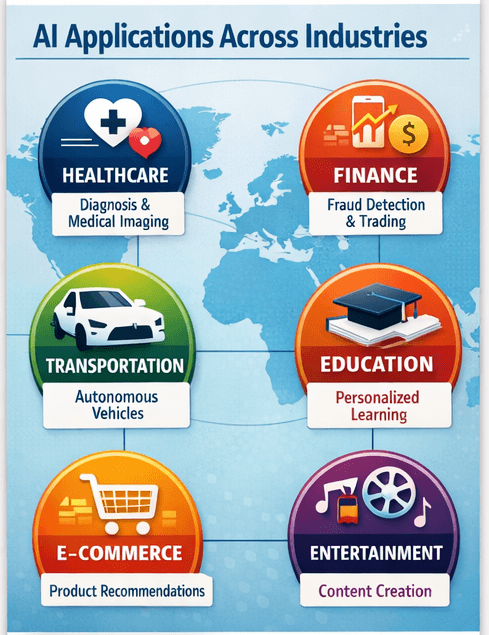
Artificial Intelligence is transforming numerous industries.
Healthcare
AI is helping doctors diagnose diseases earlier and more accurately. Medical imaging systems powered by AI can detect conditions such as cancer, heart disease, and neurological disorders.
Finance
Banks and financial institutions use AI for:
- Fraud detection
- Risk analysis
- Algorithmic trading
- Customer support chatbots
Transportation
Autonomous vehicles rely heavily on AI to analyze surroundings and make driving decisions in real time.
E-Commerce
Online retailers use AI to personalize shopping experiences, recommend products, and optimize supply chains.
Content Creation
AI tools are now capable of generating text, images, videos, and music—changing how digital content is produced.
Benefits of Artificial Intelligence
AI offers numerous advantages across industries.
IIncreased Efficiency
Automation allows businesses to perform repetitive tasks faster and with fewer errors.
Data-Driven Decisions
AI can analyze massive datasets to uncover insights that humans might miss.
Improved Customer Experiences
AI-powered chatbots and recommendation systems provide personalized services.
Innovation and New Opportunities
AI is creating entirely new industries, careers, and technological possibilities.
Challenges and Concerns
Despite its benefits, Artificial Intelligence also raises several challenges.
Job Displacement
Automation may replace certain types of jobs, especially repetitive and routine tasks.
Ethical Concerns
Issues such as algorithmic bias, privacy concerns, and misuse of AI technologies need careful regulation.
Security Risks
AI systems can potentially be used for cyberattacks, deepfakes, or misinformation if not properly controlled.
The Future of Artificial Intelligence
The future of AI looks incredibly promising. Experts believe AI will continue to evolve and integrate into nearly every aspect of human life.
Some expected developments include:
- Smarter healthcare diagnostics
- Fully autonomous transportation
- Advanced AI assistants
- AI-powered scientific discoveries
- Personalized education systems
As research progresses, AI could become one of the most influential technologies in human history.
Artificial Intelligence is rapidly transforming the world around us. From healthcare and finance to transportation and entertainment, AI is driving innovation and reshaping industries.
While challenges remain, the potential benefits of AI are enormous. With responsible development and ethical use, Artificial Intelligence can help create a smarter, more efficient, and more connected future.
For readers and businesses alike, understanding AI is no longer optional—it is essential for navigating the digital age.