
Introduction
AI agents represent the next evolution in artificial intelligence, moving beyond simple query-response systems like chatbots to autonomous entities capable of planning, reasoning, and executing complex tasks. Unlike traditional AI, which follows predefined rules, or generative AI, which creates content based on prompts, agentic AI combines decision-making with action-oriented capabilities. These systems observe situations, reason about them, decide on actions, and interact with tools or environments to achieve goals. This guide explores key concepts, real-world use cases, and practical considerations to maximize return on investment (ROI), drawing from industry insights and benchmarks.
The market for AI agents is exploding, projected to exceed $47 billion by 2030, with over 80% of companies expected to adopt them by 2026. Early adopters report significant productivity gains, cost reductions, and new revenue opportunities, but success hinges on strategic implementation, governance, and alignment with business objectives.
Key Agentic AI Concepts
Definition and Differentiation
An AI agent is a goal-driven software system that autonomously performs tasks, makes decisions, and solves problems without constant human intervention. Key differentiators:
- Autonomy: Agents design their own workflows, unlike rule-based traditional AI.
- Reasoning and Planning: They break down goals into steps, using large language models (LLMs) for logic.
- Action-Oriented: Agents interact with external tools, data sources, and APIs to execute tasks.
- Learning and Adaptation: Through memory and feedback loops, agents improve over time.
Agentic behavior exists on a spectrum:
- Conversational Agents: Handle queries using knowledge bases (e.g., customer support chatbots).
- Decisioning Agents: Prioritize and score (e.g., lead qualification).
- Orchestration Agents: Coordinate workflows across systems (e.g., integrating CRM and ERP).
- Generative Agents: Create content or code with guidelines.
- Multi-Agent Systems: Teams of agents collaborating (e.g., one for research, another for execution).
Architecture and Components
AI agents rely on interconnected components for perception, processing, decision-making, and action. Core elements include:
- Perception Layer: Gathers data from environments or user inputs.
- Reasoning Engine: Uses LLMs for planning and problem-solving.
- Memory: Stores and retrieves past interactions for context.
- Tools and Actions: Interfaces with APIs, databases, or external systems.
- Collaboration Module: Enables multi-agent interactions.
- Learning Mechanism: Refines performance based on outcomes.
A typical architecture involves a central agent powered by an LLM, connected to prompts, tools, and memory:
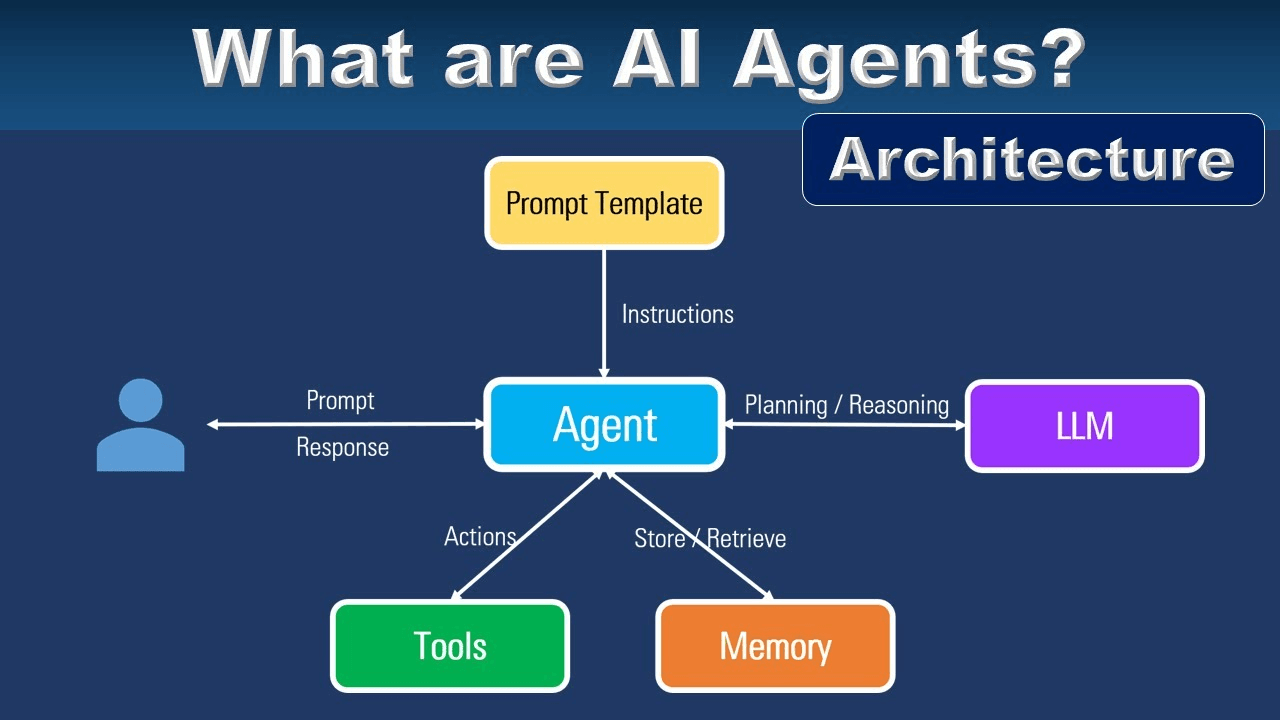
Agentic AI
Advanced features like Agentic Retrieval-Augmented Generation (RAG) allow agents to fetch and synthesize information from multiple sources for complex queries.
Use Cases and Applications
AI agents deliver high ROI by automating repetitive tasks, uncovering insights, and enabling new workflows that were previously cost-prohibitive. From X discussions, high-ROI areas include delegating repetitive work, coding assistance, deep research, and content creation, which can 10x productivity. They lower the “fixed cost” of ideas, allowing more experimentation in product development, marketing, and analysis.
By Business Function
| Function | Key Use Cases | ROI Examples |
|---|---|---|
| Sales | Lead enrichment, intent scoring, personalized outreach, pipeline forecasting, deal strategy analysis. | 25-47% productivity increase; faster deal cycles. |
| Customer Service | Self-service resolution, case triage, transcript summarization, compliance checks. | 90% of leaders report positive ROI; reduced resolution time. |
| Marketing | Content generation, campaign optimization, audience segmentation, SEO writing. | 76% achieve automation success in 1 year; increased engagement. |
| Human Resources | Resume screening, candidate matching, onboarding orchestration, sentiment analysis for retention. | 75% reduction in hiring time; improved diversity. |
| Legal | Contract review, regulatory tracking, e-discovery summarization. | Save 240 hours/year per professional. |
By Industry
| Industry | Key Use Cases | ROI Examples |
|---|---|---|
| Financial Services | Fraud detection, report generation, personalized advice, trade monitoring. | 43% boost in efficiencies; up to 30% cost savings. |
| Healthcare | Prior authorizations, chart triage, follow-up management, coding audits. | $3.20 return per $1 invested in 14 months. |
| Insurance | Underwriting acceleration, claims processing, fraud detection, policy services. | 30% operational cost savings. |
| Retail/E-commerce | Dynamic pricing, product content enrichment, conversational shopping, inventory sync. | 25% increase in conversions. |
| Manufacturing/Logistics | Predictive maintenance, quality inspection, supply chain re-routing, demand planning. | 61% report decreased costs. |
Real-world examples include AI agents for sales demo research (pulling LinkedIn data), claims automation in insurance (assessing risks from inputs), and supply chain risk assessment in manufacturing. Vertical-specific agents, like those in coding or security, thrive where talent shortages exist, offering immediate value.
To maximize ROI, focus on measurable outcomes beyond efficiency, such as revenue growth (prioritized by 50% of top performers) and business-model innovation (43%). Key considerations:
- Alignment with Objectives: Tie agents to specific goals like cost savings or faster decisions. Start with high-volume, repeatable tasks.
- Data Quality and Governance: Ensure access to accurate data; implement standards for security and compliance.
- Ethical Deployment: Address biases, transparency, and human oversight to build trust.
- Scalability: Use frameworks for development; price for adoption (e.g., subscriptions) to gain market share.
- Risk Management: Include guardrails for safe actions; monitor for hallucinations or errors.
Overall, 7/10 companies use agents as their primary automation lever, with 2/3 seeing productivity gains.
Practical Roadmap for Implementation
- Define Goals: Identify one use case with clear KPIs (e.g., 30% backlog reduction).
- Build and Test: Start small—prototype an agent, connect tools, and trial with 5-10 users. Measure before/after impacts.
- Establish Governance: Form an AI council with cross-functional teams for standards and prioritization.
- Scale and Iterate: Use insights from pilots to expand; leverage frameworks like those from IBM for deployment.
- Monitor ROI: Track metrics like time savings, cost reductions, and new opportunities over multi-year horizons.
For deeper dives, resources like IBM’s “Unlock AI ROI” guidebook offer tactical strategies. By focusing on vertical-specific agents and rapid iteration, businesses can capitalize on this window of opportunity.


Comments are closed.