
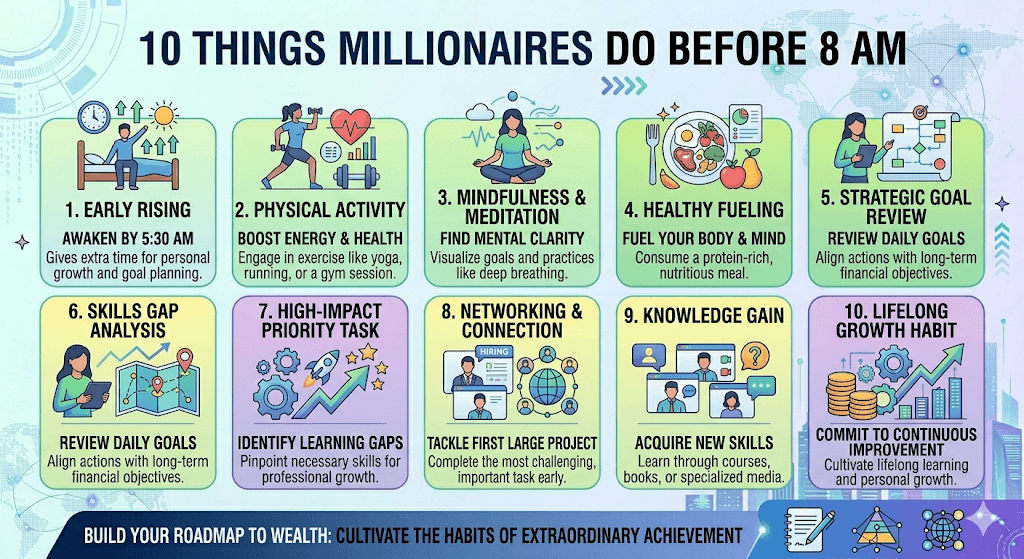
It’s not about waking up at 4 AM and suffering through cold showers to prove you’re serious about success. It’s about the quiet, deliberate choices made before the world wakes up — and why they compound over time.
Let’s get one thing straight from the jump: waking up early won’t make you a millionaire. But here’s the thing — nearly every self-made millionaire, when you study their lives closely, has one thing in common: they own their mornings.
Research from Ohio State University’s Thomas Corley, who spent five years studying 233 wealthy individuals, found that 44% of them woke up at least three hours before their workday began. That’s not a coincidence. The morning is the one block of time in the day that’s entirely yours — before emails, obligations, and other people’s priorities take over.
Here are the 10 things they actually do with it.
They wake up before the world demands things from them
The alarm isn’t the enemy. The trap is waking up reactive — already behind, already responding. Most millionaires don’t set their alarm for 5 AM because some guru told them to. They do it because quiet time is leverage.
Apple CEO Tim Cook starts his day at 3:45 AM. Howard Schultz, Starbucks founder, at 4:30. Neither does it to impress anyone — they do it because those early hours belong entirely to them.
They don’t touch their phone first
This one will feel impossible at first. And that’s exactly why it matters.
About 80% of people check their phone within five minutes of waking up. Research shows that seeing even a mildly stressful message — an urgent email, a news alert, a comment on a post — activates your stress response and primes your brain for distraction for the rest of the day.
Millionaires understand that attention is their most valuable asset. They protect it from the moment they open their eyes. The emails will still be there at 8. The news will still exist. But the focused morning mind? That’s a limited window.
They move their body — intentionally
Not a leisurely stretch. Not a casual scroll on a stationary bike. Intentional physical activity that gets the heart rate up and floods the brain with neurochemicals that make everything else work better.
Mark Zuckerberg trains in combat sports. Satya Nadella credits just 30 minutes of exercise with maintaining his mental sharpness as Microsoft CEO. They’re not doing it for the six-pack. They’re doing it for the cognitive edge.
They sit with silence — and often meditate
Once dismissed as mysticism, meditation is now a recurring fixture in the morning routines of CEOs, investors, and founders. Not because it’s trendy — but because the research on what it does to a high-pressure brain is hard to ignore.
Oprah commits 20 minutes every morning to meditation. Bill Gates — once a skeptic — now practices it two to three times a week. Marc Benioff of Salesforce meditates himself and has built meditation rooms into his office buildings. These aren’t spiritual gestures. They’re performance tools.
They read — almost every single morning
Warren Buffett reads 500 pages a day. That’s an extreme. But his underlying logic isn’t: knowledge compounds. Like interest, the more you put in, the more you get back — slowly at first, then faster than you’d believe.
Bill Gates reads 50 books a year and takes annual “Think Weeks” dedicated purely to reading and reflection. Elon Musk taught himself rocket science primarily through books. The pattern is consistent: people who build great things tend to be people who read constantly.
They write things down — goals, gratitude, or both
There’s something quietly powerful about putting words on paper before the day begins. It doesn’t matter if it’s three lines in a battered notebook or a structured journal — the act of writing anchors your mind to what actually matters.
Oprah Winfrey has kept a gratitude journal for decades, writing down five things she’s grateful for each morning. She credits it with fundamentally shifting her outlook. Research on gratitude journaling consistently shows reduced anxiety and increased optimism — not trivial for someone making high-stakes decisions all day.
They eat (or don’t) with intention
The relationship between millionaires and breakfast is more nuanced than “eat a power meal.” Some are devoted to nutritious, high-protein mornings. Others practice intermittent fasting. What they share isn’t a specific diet — it’s intentionality about what they put in their body before a demanding day.
Jack Dorsey famously practices intermittent fasting, eating just one meal a day. Others like Arianna Huffington have moved away from skipping meals entirely. The point isn’t to copy a specific approach — it’s to stop eating mindlessly and start eating strategically.
They review their goals and plan their day
It sounds boring. It is, in the best possible way. The millionaire’s morning isn’t usually glamorous — it often includes five quiet minutes reviewing what matters this week, this month, this year, and then mapping that onto today.
James Clear, author of Atomic Habits, frames it this way: you don’t rise to the level of your goals, you fall to the level of your systems. The morning review is where the system gets loaded. Robin Sharma puts it even more bluntly: “Own your morning. Elevate your life.”
They do the small, unglamorous thing — like making their bed
This one surprises people every time. Making your bed? That’s a wealth habit?
Sort of. It’s less about the bed and more about what it represents: a small, completed task done with care before the day even begins. A signal to your own brain that when there’s a job to do, you do it.
Naval Admiral William McRaven made this famous in his 2014 University of Texas commencement speech: “If you make your bed every morning, you will have accomplished the first task of the day.” Momentum compounds from the first moment.
They do something uncomfortable — on purpose
Cold showers. Hard workouts. Ten minutes of deep work on the project they’ve been avoiding. The specific discomfort varies. The intention doesn’t: do something hard early, and everything after feels easier by comparison.
Jack Dorsey starts each day with an ice-cold bath. Dwayne Johnson has credited cold showers with jumpstarting his mornings for years. WHOOP CEO Will Ahmed pairs cold showers with meditation as his daily non-negotiables. The research is still evolving, but the pattern among high performers is remarkably consistent.
The real secret? None of this is secret.
Every single habit on this list is free. Most take under an hour combined. None of them require a standing desk or a $200 wellness subscription or a villa in Malibu to pull off.
What they require is consistency, and that’s where most people quietly opt out. Not because they don’t know what to do — but because the morning is comfortable, and these habits are occasionally not.
Here’s the thing about millionaires: they’re not superhuman. They’re not operating with a different 24 hours. What they’ve done, often over years, is build mornings that front-load intention, energy, and clarity — so that by the time the world comes at them, they’re already ahead.
You don’t have to do all ten. Start with two. Do those two every day for 30 days. Watch what happens to how you feel, how you focus, and how you move through the rest of your day.
The compound interest of good habits is just as real as financial compound interest. It just shows up differently.